

Behavior Based Safety Software | Digitize BBS Observation Management
Behaviour-based safety software helps organizations systematically monitor, record, and improve employee safety behaviours at the workplace. It enables safety teams to capture BBS observations, identify safe and unsafe behaviours, assign corrective actions, track improvements, and analyze recurring trends through a centralized digital platform. By replacing manual observation records and spreadsheets with structured digital workflows, behaviour-based safety software improves employee engagement, strengthens safety awareness, and supports a proactive approach to preventing incidents and workplace injuries. It also helps organizations identify high-risk behaviours before they result in incidents, allowing timely preventive action. Safety managers can monitor observation trends, recognize positive safety practices, and focus improvement efforts on areas that require attention. With real-time access to safety data and reports, organizations can build a stronger safety culture and continuously improve workplace safety performance.
What Is Behavior Based Safety Software?
Behavior Based Safety Software (BBS Software) is a digital solution for managing workplace safety observations and behavior-based safety programs. It enables organizations to record observations, classify safe and at-risk behaviors, identify recurring patterns, assign corrective actions and monitor safety performance through structured data and analytics.
Instead of maintaining BBS observation cards, spreadsheets and separate reports, organizations can use a centralized platform to manage the complete observation lifecycle.
A digital BBS system can help safety teams:
- Record workplace safety observations
- Identify safe and at-risk behaviors
- Categorize observations
- Capture photographs and evidence
- Assign corrective actions
- Track action completion
- Analyze observation trends
- Monitor employee participation
- Generate reports
- Review site and department performance
The objective is to turn everyday workplace observations into useful safety information for proactive safety management and continuous improvement.
Categories of Behavioral Safety Observations
Personal Protective Equipment (PPE)
Observations related to the correct selection, availability, condition and use of required PPE.
Examples include:
- ⛑️ Safety helmets
- 🥾 Safety footwear
- 👁️ Eye protection
- 🧤 Hand protection
- 👂 Hearing protection
- 😷 Respiratory protection
- 🦺 Fall protection
- 🛡️ Task-specific PPE
Position of People
This category focuses on how employees position themselves in relation to workplace hazards while performing tasks.
Examples include:
- ⚠️ Line-of-fire exposure
- 🤏 Pinch points
- ⚙️ Moving machinery
- 🚛 Vehicle movement
- 🏗️ Lifting operations
- 🏗️ Working at height
- 🧍 Unsafe body positioning
Reaction of People
This category examines how employees respond to hazards, abnormal situations and changing workplace conditions.
Examples include:
- 📢 Reporting hazards
- 🚨 Responding to alarms
- 🛑 Stopping unsafe work
- 💬 Communicating hazards
- 🚒 Following emergency requirements
- 🔄 Responding to changing conditions
Procedures and Work Methods
This category focuses on adherence to established procedures and safe work methods.
Examples include:
- 📋 SOP compliance
- 📖 Work instructions
- 📝 Permit requirements
- ✅ Pre-job checks
- ⚠️ Risk assessment
- 🔒 Isolation requirements
- 🛠️ Approved work methods
Tools and Equipment
This category covers the safe selection, condition and use of tools and equipment.
Examples include:
- 🔧 Correct tool selection
- 🔍 Pre-use inspection
- ⚙️ Equipment condition
- 🛡️ Machine guarding
- ❌ Defective equipment
- ▶️ Correct equipment operation
- 🗄️ Tool storage
Housekeeping and Workplace Conditions
This category focuses on workplace organization and conditions that may affect safe work.
Examples include:
- 📦 Material storage
- 🗑️ Waste management
- 💧 Spills
- 🚪 Access and egress
- 🚧 Obstructions
- 🔌 Cables and hoses
- ⚠️ Slip and trip hazards
- 🚨 Emergency access
What Are Challenges with Paper-Based Behaviour Based Safety Management?
⏱️ Delayed Safety Observation Reporting
Paper forms often require manual collection and data entry. This delays BBS observation reporting and prevents safety teams from responding quickly to unsafe behaviours or emerging workplace risks.
⚠️ Risk of Lost or Inaccurate Records
Handwritten records can be incomplete, difficult to read, misplaced, or incorrectly entered. This affects the reliability of behaviour-based safety data and makes accurate safety performance analysis more difficult.
👁️ Limited Real-Time Visibility
Paper-based systems do not provide real-time dashboards or instant visibility. Managers may struggle to identify unsafe behaviour trends, recurring observations, and areas requiring immediate preventive action.
👥 Reduced Employee Participation
Employees may be less willing to complete lengthy paper forms. A digital BBS observation management system simplifies reporting and encourages greater participation in workplace safety activities.
👤 Weak Accountability and Follow-Up
Paper-based tracking makes it harder to monitor who reported an observation, who owns the corrective action, and whether it was completed. Digital BBS software creates better accountability and follow-up.
🔧 Difficult Corrective Action Tracking
Tracking corrective actions through paper records can lead to missed responsibilities and deadlines. A BBS management system helps assign actions, monitor progress, and improve accountability.
📊 Difficult Trend Analysis
Analysing hundreds of paper observations requires significant manual effort. Behaviour safety analytics becomes difficult, limiting the organization’s ability to identify recurring behaviours and develop targeted improvement initiatives.
📁 Poor Accessibility of Historical Data
Paper files require physical storage and manual searching. Retrieving previous safety observation records can take considerable time, especially during audits, management reviews, or incident investigations.
Why Organizations Need Digital Behaviour-Based Safety Management?
Traditional BBS programs may depend on paper forms, spreadsheets and manual consolidation. As the number of employees, observations, departments and locations increases, managing this information can become difficult.
QHSEAlert provides a digital approach to BBS observation management by bringing observation collection, categorization, action management and analytics into one system.
Replace Paper-Based BBS Observations
Record observations digitally instead of using paper observation cards. This creates a more structured and accessible record of workplace observations.
Reduce Excel-Based Safety Management
Avoid manually consolidating observations from multiple spreadsheets. A centralized BBS Observation Management system can organize information in one platform.
Improve Visibility of Safety Behaviors
Identify where safe and at-risk behaviors are being observed and understand recurring patterns across departments, activities and locations.
Improve Corrective Action Follow-Up
Connect observations with corrective or improvement actions and monitor their progress.
Analyze Behavioral Safety Trends
Use Behavioral Safety Analytics to examine observation categories, behavior trends, participation and corrective-action information.
Encourage Employee Participation
Provide employees and supervisors with a structured digital process for contributing to the organization’s Behavior Based Safety Program.
How BBS Observation Software Works
1. Observe
Employees, supervisors or safety professionals observe workplace activities.
2. Record
The observation is entered into the digital BBS Software.
3. Categorize
The observation is classified according to the organization’s BBS observation categories.
4. Identify
The observation can identify safe behavior, at-risk behavior or an opportunity for improvement.
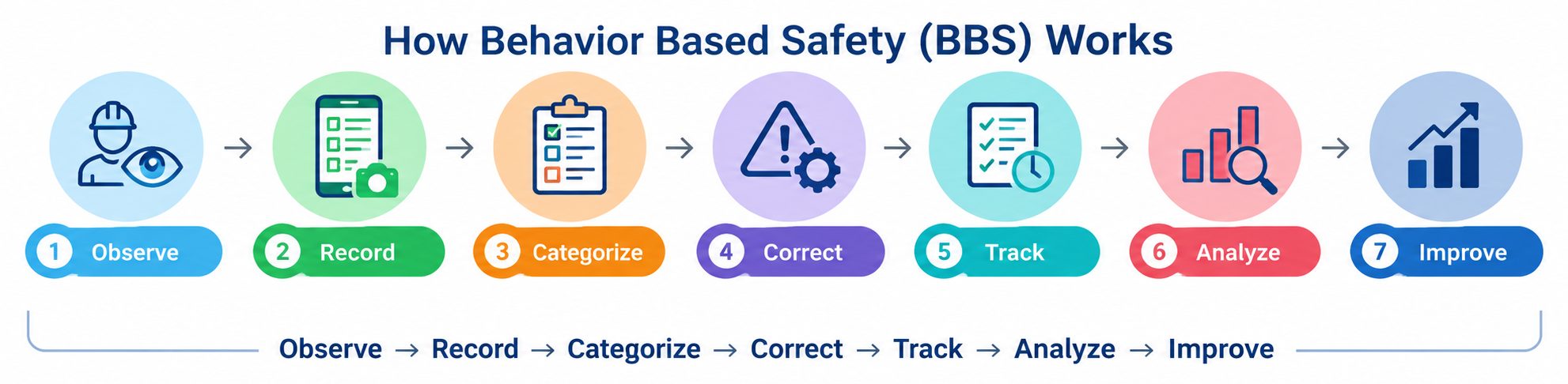
5. Correct
Where required, corrective or improvement actions can be assigned.
6. Track
Responsible persons and action status can be monitored.
7. Analyze
Collected data can be reviewed through BBS Analytics, dashboards and reports.
8. Improve
Safety teams can use the information to identify recurring patterns and improvement opportunities.
Key Features of BBS Safety Management Software
Digital Safety Observation Management
Capture workplace observations electronically from the point of observation.
Record information such as:
- Date and time
- Site and location
- Department
- Activity
- Observation category
- Safe or at-risk behavior
- Observation description
- Photographs
- Corrective actions
- Responsible person
- Target date
- Closure status
This provides a structured approach to Safety Observation Management.
Custom BBS Observation Categories
Every organization has different activities, hazards and operational requirements.
BBS Software can provide configurable observation categories according to the organization’s requirements.
Common categories include:
- Personal Protective Equipment
- Position of People
- Reaction of People
- Procedures and Work Methods
- Tools and Equipment
- Housekeeping
- Workplace Conditions
Additional categories can be structured around specific activities, processes or workplace risks where required.
Behavioral Safety Analytics
Transform observation data into useful information through Behavioral Safety Analytics.
Analyze observations by:
- Category
- Department
- Site
- Location
- Activity
- Observer
- Behavior type
- Date
- Action status
This allows safety teams to move beyond simply collecting observations and begin identifying recurring trends.
Corrective Action Management
An observation may require an immediate correction, follow-up action or improvement activity.
A digital BBS Observation Management System can connect observations with:
- Corrective actions
- Responsible persons
- Target dates
- Action status
- Closure information
- Verification
This creates a clear connection between observation → action → follow-up.
Photo and Evidence Capture
Add photographs and supporting information to BBS observations where appropriate.
Visual evidence can provide additional context for safety professionals when reviewing observations, identifying issues and following up corrective actions.
BBS Dashboards and Reports
Use dashboards and reports to provide management with visibility into the organization’s Behavior Based Safety Program.
Review information such as:
- Total observations
- Safe observations
- At-risk observations
- Category-wise observations
- Department-wise observations
- Site-wise observations
- Observation trends
- Corrective actions
- Action closure
- Participation
Benefits of Behavior Based Safety Management Software
Improve Proactive Safety Management
Use workplace observation information to understand behaviors and identify opportunities for improvement.
Reduce Manual Data Management
Reduce the effort involved in collecting, consolidating and reporting observations.
Improve Safety Data Visibility
Provide safety teams with structured information about observations across the organization.
Strengthen Corrective Action Follow-Up
Connect observations to responsible persons and corrective actions.
Identify Recurring Behavioral Trends
Analyze historical observations to identify frequently occurring behaviors or categories.
Improve Employee Participation
Provide employees and supervisors with a structured digital process for participating in safety observations.
Standardize BBS Observation Processes
Establish a consistent approach to recording and managing Behavior Based Safety Observations.
Support Data-Driven Safety Decisions
Use BBS Analytics to provide management with information for safety reviews and improvement planning.
Digital Behaviour Based Safety Software for Different Industries
- ✔ Oil & Gas
- ✔ Construction
- ✔ Manufacturing
- ✔ Chemicals & Petrochemicals
- ✔ Mining
- ✔ Power & Utilites
- ✔ Cement
- ✔ Food & Beverage
- ✔ Marine & Offshore
- ✔ Infrastructure

BBS Software vs. Paper OR Excel-based BBS Program
| Manual BBS Management | Digital BBS Software |
|---|---|
| Paper observation forms | Digital observations |
| Multiple Excel files | Centralized data |
| Manual data consolidation | Structured digital records |
| Manual trend analysis | BBS analytics |
| Separate action tracking | Integrated action management |
| Delayed reporting | Faster information access |
| Difficult multi-site consolidation | Centralized multi-site management |
| Manual reports | Digital reports and dashboards |
| Difficult historical analysis | Searchable observation data |
Report & Dashboard of BBS Safety Observation Management Software
Safe vs. At-Risk Behavior Analysis
Understand the distribution of safe and at-risk observations within the available data.
Category-Wise Analysis
Identify which BBS observation categories generate frequent observations.
Department-Wise Analysis
Review behavioral observation trends across departments and functions.
Site-Wise Analysis
Monitor observation activity across different facilities and locations.
Activity-Wise Analysis
Identify observations associated with particular jobs, tasks or activities.
Corrective Action Analysis
Monitor actions resulting from observations and their current status.
Participation Analysis
Review participation in the Behavior Based Safety Program across relevant employee groups.
BBS Software KPIs
| KPI | What It Shows |
|---|---|
| Total observations | Overall observation activity |
| Safe observations | Positive behaviors observed |
| Category-wise observations | Frequently observed categories |
| Department-wise observations | Behavioral trends by department |
| Site-wise observations | Trends across locations |
| Observation trends | Changes over time |
| Employee participation | Workforce involvement |
| Corrective actions | Actions resulting from observations |
| Action closure | Follow-up status |
| Repeat observations | Recurring behavioral issues |
A digital BBS Observation Management Software solution can help organizations structure and monitor key observation metrics. These metrics provide additional proactive safety information that can complement incident, injury and other QHSE performance indicators.
Implement and Support For BBS Safety Software
⚙️ BBS Software Implementation
QHSEalert helps organizations implement Behaviour Based Safety Software by configuring observation forms, categories, workflows, users, departments, sites, and reporting requirements to support a structured Behaviour Based Safety Management process.
📝 Customization of BBS Observation Management
Every workplace has different risks and activities. BBS Observation Software can be configured with customized observation categories, safe and at-risk behaviours, corrective actions, responsibilities, and workflows based on organizational requirements.
🎓 User Training and Support
QHSEalert provides guidance and user support for Behaviour Based Safety Management Software, helping safety teams, supervisors, employees, and other users understand digital observation reporting, action tracking, dashboards, and BBS Analytics.
🛠️ Ongoing BBS Software Support
Ongoing support helps organizations maintain effective BBS Observation Management after implementation. Support can assist with workflow improvements, configuration changes, user requirements, reporting needs, and continuous improvement of the Behaviour Based Safety Program.
📈 Improve Your Behaviour Based Safety Program
With structured implementation and ongoing support, Behaviour Based Safety Software helps organizations move from paper forms and spreadsheets to centralized digital observation management, corrective-action tracking, behavioural trend analysis, and data-driven safety improvement.
Why Choose QHSEAlert for BBS Observation Management?
QHSEAlert provides a digital approach to Behavior Based Safety Observation Management, helping organizations move from manual observation processes toward structured digital safety management.
With QHSEAlert, organizations can bring BBS activities into a centralized QHSE environment.
QHSEAlert Can Help You
- Digitalize BBS observations
- Manage safe and at-risk behaviors
- Configure observation categories
- Capture observation information
- Manage corrective actions
- Analyze behavioral safety trends
- Monitor participation
- Generate reports
- Manage observations across locations
- Connect BBS activities with broader QHSE processes
Instead of treating safety observations as isolated forms or spreadsheets, organizations can create a connected process for observation, action, analysis and improvement.
BBS Safety Software - Technical Information
| ATTRIBUTE | DETAILS |
|---|---|
| Software Name | QHSEAlert EHS Module |
| Category | BBS Safety Observation Software |
| Software Type | Cloud-Based (SaaS) |
| Deployment | Web-Based Application |
| Primary Purpose | Digital Reporting, Followup, Closing & Analysis of BBS Observations |
| Mobile Access | Yes |
| Paperless Workflow | Yes |
| Unlimited Users | Yes |
| Unlimited Observations | Yes |
| Custom BBS Category | Yes |
| Approval Workflow | Configurable Multi-Level Workflow |
| Audit Trail | Complete Digital Audit Trail |
| Real-Time Dashboard | Yes |
| Reports & Analytics | Yes |
| Contractor Management | Yes |
| Photo & Document Attachments | Yes |
| Role-Based Access Control | Yes |
| Industry Support | Multiple Industries |
BBS Safety Software - Security & Data Privacy
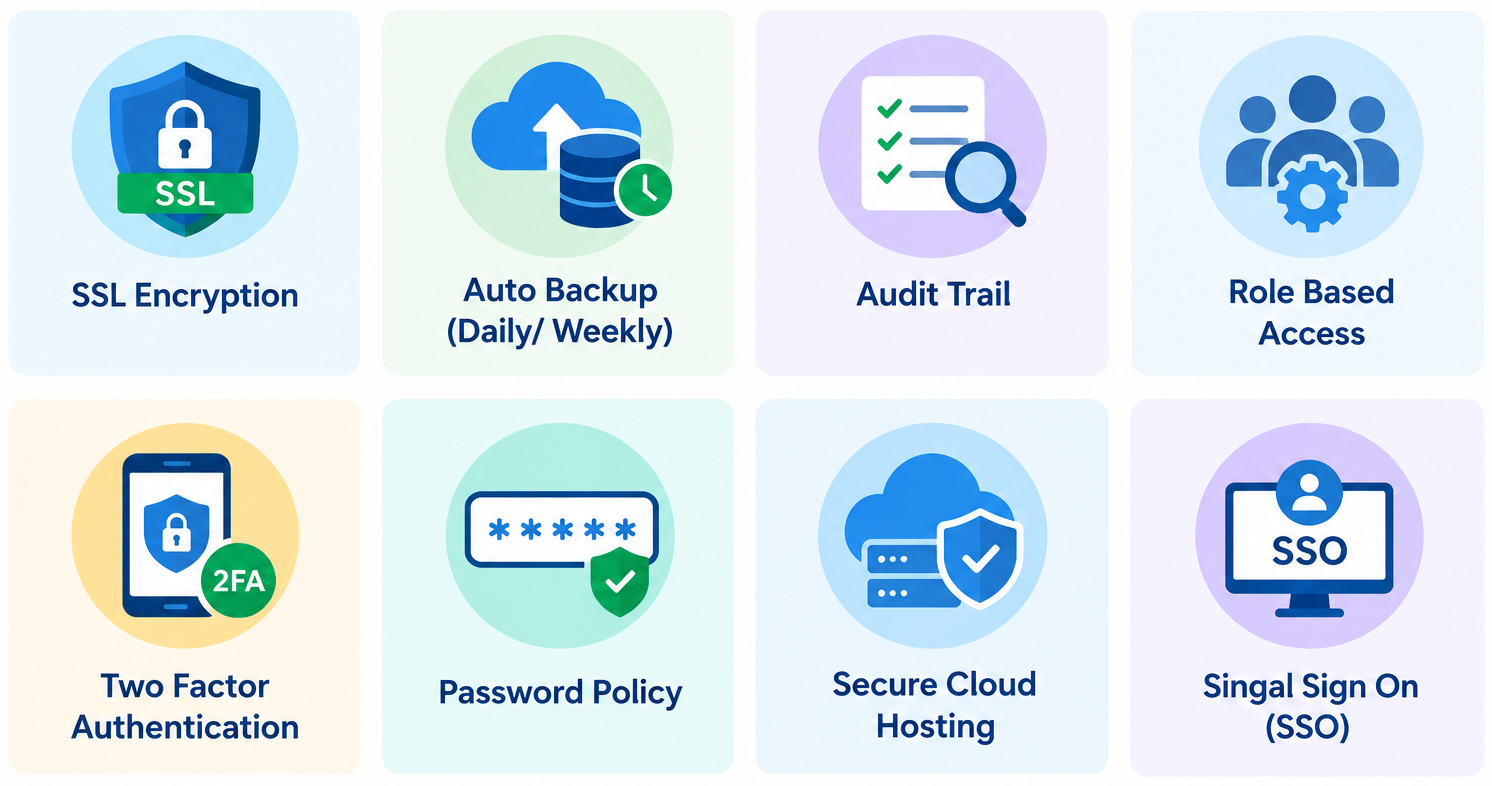
- ✔ SSL Encryption
- ✔ Auto Backup (Daily/Weekly)
- ✔ Audit Trail
- ✔ Role-Based Access
- ✔ Two-Factor Authentication
- ✔ Password Policy
- ✔ Secure Cloud Hosting
- ✔ Single Sign-On (SSO)
Frequently Asked Questions About BBS Software
What is Behavior Based Safety Software?
- Behavior Based Safety Software is a digital solution used to record, manage and analyze workplace safety observations and behaviors as part of a Behavior-Based Safety program.
What is BBS Observation Management?
- BBS Observation Management is the process of recording workplace observations, categorizing behaviors, identifying improvement opportunities, assigning actions and monitoring trends.
What is BBS Observation Software?
- BBS Observation Software is a digital tool that enables organizations to collect, manage, analyze and report Behavior-Based Safety observations.
What is BBS Software used for?
- BBS Software is used to digitize safety observations, classify safe and at-risk behaviors, manage corrective actions, analyze trends and generate reports.
What are the main categories of behavioral safety observations?
- Common categories include PPE, Position of People, Reaction of People, Procedures and Work Methods, Tools and Equipment, and Housekeeping and Workplace Conditions.
Can BBS Software replace paper observation cards?
- A digital BBS Observation Management System can replace paper-based observation forms by allowing observations to be recorded and managed electronically.
Can BBS Software replace Excel for safety observations?
- Digital Behavior Based Safety Software can centralize observation information and reduce the need to manually consolidate and analyze observations in spreadsheets.
Can BBS observation categories be customized?
- BBS observation categories can be configured according to an organization’s activities, processes, hazards and Behavior-Based Safety methodology, depending on the capabilities of the selected software.
Can BBS Software manage corrective actions?
- Yes. A BBS Observation Management Software solution can connect observations with corrective or improvement actions and provide action tracking functionality.
Can BBS Software provide analytics?
- Yes. BBS Analytics can include observation trends, categories, departments, locations, safe and at-risk behaviors, participation and corrective-action information.
Who can use Behavior Based Safety Software?
- Safety professionals, EHS managers, supervisors, employees, contractors and management teams can use BBS Software, depending on the organization’s workflow and access structure.
What is the difference between BBS Software and Safety Observation Software?
- BBS Software focuses specifically on behavior-based safety observations and behavioral trends. Safety Observation Software can have a broader scope and may include unsafe conditions, hazards, positive observations and other safety observations.