

Deviation Management Software
Deviation Management Software helps organizations digitally record, investigate, track and close deviations from defined processes, procedures, specifications or requirements. QHSEalert provides a centralized platform for managing deviation records, assigning responsibilities, monitoring corrective actions and maintaining visibility of deviation status from identification through closure.
Instead of relying on spreadsheets, emails and disconnected records, organizations can use a deviation management system to standardize workflows, improve accountability and maintain a traceable history of investigations and actions.
What Is Deviation Management Software?
Deviation Management Software is a digital system used to identify, document, investigate and resolve deviations from approved processes, procedures, specifications or established requirements.
A deviation tracking system provides a structured workflow for recording what happened, assessing the issue, identifying the root cause, assigning corrective actions and monitoring progress until the deviation is closed.
For QHSE and quality teams, digital deviation management provides greater visibility than manual registers and spreadsheets. It can also connect deviation records with corrective actions, investigations, audits and other quality activities.
What Is a Deviation?
A deviation occurs when an actual process, activity, result or condition differs from an approved procedure, specification, requirement or expected outcome.
Examples may include:
- Process deviations
- Production deviations
- Quality deviations
- Procedure deviations
- Equipment-related deviations
- Material-related deviations
- Documentation deviations
- Environmental or operational deviations
- Supplier-related deviations
- Inspection or audit-related deviations
Why Use Deviation Management Software?
Manual deviation registers can make it difficult to track responsibilities, investigation progress, overdue actions and closure status.
A deviation management system provides a centralized approach for controlling deviation records and associated actions.
Replace Manual Deviation Tracking
Move away from spreadsheets, paper forms and email-based follow-ups by maintaining deviation information in one centralized system.
Improve Accountability
Assign deviation investigations and corrective actions to responsible persons with defined target dates and status tracking.
Track Deviations from Identification to Closure
Maintain visibility throughout the deviation lifecycle—from initial reporting and investigation through corrective action and final closure.
Improve Audit Readiness
Maintain structured deviation records and supporting information so quality and QHSE teams can retrieve relevant information when required.
Deviation Management Workflow
1. Identify the Deviation
Record the deviation as soon as it is identified and capture the relevant details about the event, process or requirement involved.
2. Record the Deviation
Create a centralized deviation record containing relevant information, supporting documents, photographs, observations and other evidence.
3. Assess the Deviation
Evaluate the deviation and determine its significance, impact and priority according to your organization’s defined process.
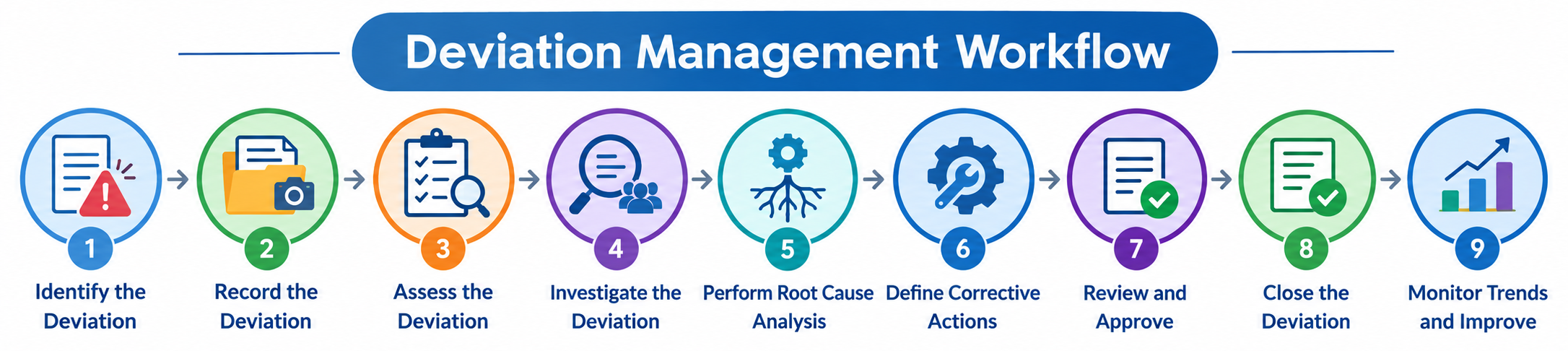
4. Investigate the Deviation
Assign the deviation to the responsible person or team and document investigation findings, observations and evidence.
5. Perform Root Cause Analysis
Identify the underlying cause of the deviation using an appropriate root cause analysis methodology.
6. Define Corrective Actions
Create corrective actions to address the identified causes and assign responsibility and target completion dates.
7. Review and Approve
Route the deviation through the organization’s defined review and approval process.
8. Close the Deviation
Verify that required actions have been completed and close the deviation with the appropriate supporting records.
9. Monitor Trends and Improve
Analyze historical deviation information to identify recurring issues, trends and opportunities for continuous improvement.
Key Features of QHSEalert Deviation Management Software
📋 Centralized Deviation Register
Maintain deviation records in a centralized digital system rather than relying on separate spreadsheets, files or emails.
📝 Deviation Reporting
Create and document deviation records with relevant information, observations and supporting evidence.
🗂️ Deviation Classification
Classify deviations according to categories, departments, processes, locations, severity or other parameters defined by your organization.
🔍 Investigation Management
Assign investigations to responsible users and monitor investigation progress through the defined workflow.
🎯 Root Cause Analysis
Document investigation findings and identify the root cause or contributing factors associated with the deviation.
✅ Corrective Action Tracking
Assign corrective actions, responsible persons and target dates while monitoring completion status.
Supporting Documents and Evidence
Maintain relevant documents and evidence against the deviation record to improve traceability.
🔔 Alerts and Notifications
Notify responsible users about assigned activities, pending actions and important due dates.
📈 Dashboard and Reports
Monitor deviation status, ageing, trends, categories, departments and closure performance through dashboards and reports.
📊 Deviation Status Tracking
Track deviations according to their current status, such as:
- Open
- Under Investigation
- Action Pending
- Under Review
- Closed
- Overdue
Deviation Dashboard and Analytics
Deviation Trend Analysis
Analyze deviations over time to identify increasing, decreasing or recurring patterns.
Department-Wise Deviations
Identify departments generating or receiving the highest number of deviations.
Process-Wise Deviations
Analyze deviations according to processes or activities.
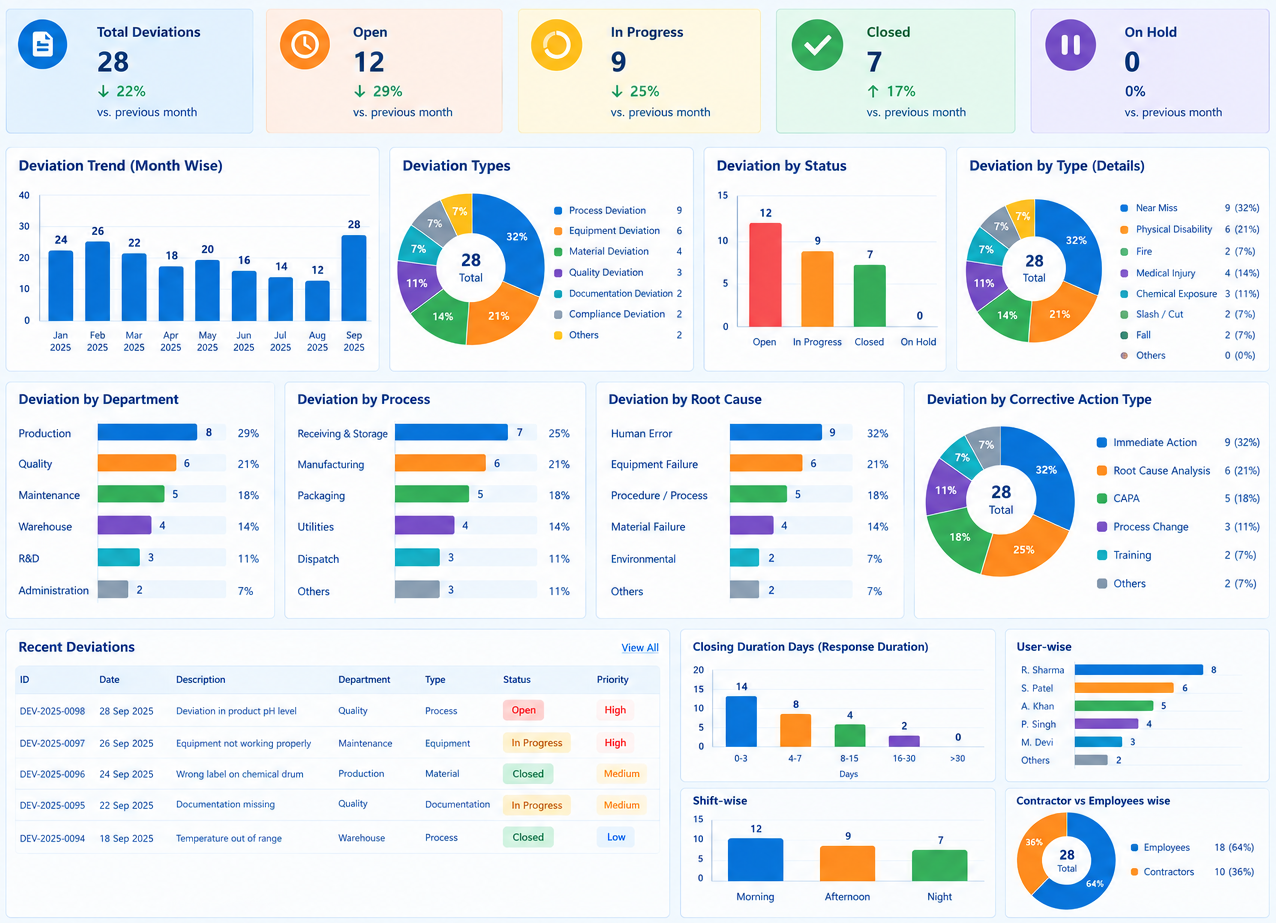
Category-Wise Deviations
Identify the most common deviation categories and issue types.
Status-Wise Deviations
Monitor open, under-investigation, pending-action and closed deviations.
Root Cause Analysis
Analyze recurring root causes to identify systemic problems requiring further action.
Benefits of Deviation Management Software
📋 Centralized Quality Information
Manage deviation information through one centralized platform with controlled access.
⏱️ Faster Deviation Closure
Improve follow-up by assigning actions and monitoring target dates.
👁️ Better Visibility
Management and QHSE teams can quickly understand the current status of deviations and corrective actions.
👤 Improved Accountability
Clearly define who is responsible for investigation, action, review and closure.
⚙️ Reduced Manual Work
Reduce dependence on spreadsheets, paper forms and manual follow-up.
🔍 Better Traceability
Maintain a structured history of deviation activities, actions and supporting evidence.
📈 Continuous Improvement
Use deviation trends and root-cause information to identify recurring problems and improvement opportunities.
Deviation Management Software for QHSE Teams
QHSEalert Deviation Management Software is designed for organizations that need a structured digital process for managing deviations and quality issues. QHSE teams can use the system to record deviations, coordinate investigations, monitor corrective actions and track closure across departments and locations.
The centralized approach can help organizations connect deviation management with broader QHSE management, quality assurance and continuous improvement activities.
Deviation Management Software and CAPA
Deviation management and CAPA are closely connected quality-management activities. A deviation may require corrective or preventive action depending on its cause, impact and organizational procedure. QHSEalert can be positioned as the system for managing the deviation lifecycle while supporting follow-up actions required to address identified causes and prevent recurrence.
Important: Not every deviation automatically becomes a CAPA. The need for CAPA should be determined according to the organization’s investigation findings.
Who Can Use Deviation Management Software?

✓ Quality Assurance Teams
✓ Quality Control Teams
✓ QHSE Teams
✓ Production Teams
✓ Operations Teams
✓ Management
Industries That Can Use Deviation Management Software
- ✓ Manufacturing
- ✓ Chemical
- ✓ Pharmaceutical
- ✓ Food and Beverage
- ✓ Engineering
- ✓ Automotive
- ✓ Oil and Gas
- ✓ Petrochemical
- ✓ Textile
- ✓ Packaging
- ✓ Construction
- ✓ Infrastructure
- ✓ Healthcare
- ✓ Laboratory

Deviation Management Software vs Manual Deviation Tracking
| Activity | Manual Tracking | QHSEalert Deviation Software |
|---|---|---|
| Deviation reporting | Paper/Excel/email | Centralized digital record |
| Assignment | Manual follow-up | Assigned responsibility |
| Investigation | Separate documents | Structured workflow |
| Corrective actions | Spreadsheet tracking | Action tracking |
| Due dates | Manual monitoring | Status and alerts |
| Evidence | Separate folders | Linked to records |
| Status visibility | Difficult | Centralized dashboard |
| Trend analysis | Manual | Digital reports |
| Traceability | Limited | Structured record history |
| Management review | Manual compilation | Dashboard-based information |
How QHSEalert Deviation Management Software Supports Continuous Improvement
Effective deviation management should not end when an individual record is closed. Historical deviation data can provide valuable information about recurring problems, process weaknesses and areas requiring improvement. QHSEalert helps organizations organize deviation information so QHSE and quality teams can review trends, monitor corrective actions and use historical information to support continuous improvement.
Why Choose QHSEalert Deviation Management Software?
- Centralized deviation management – Manage deviation records and activities from one platform.
- Structured workflow – Follow a defined process from reporting through closure.
- Better accountability – Assign responsibilities and monitor action completion.
- Improved visibility – Monitor deviation status and ageing.
- Data-driven decisions – Analyze deviation trends and recurring causes.
- Audit-ready records – Maintain organized information and supporting evidence.
- Scalable QHSE platform – Connect deviation management with other QHSE processes.
- Cloud-based access – Access the application across locations and devices, subject to your configured deployment.
Frequently Asked Questions About Deviation Management Software
What is deviation management software?
- Deviation management software is a digital solution used to record, investigate, track and close deviations from approved processes, procedures, specifications or requirements. It provides a structured workflow for assigning investigations, documenting root causes, tracking corrective actions and maintaining records through closure.
What is the purpose of deviation management?
- The purpose of deviation management is to ensure that deviations are properly recorded, assessed, investigated and resolved. It helps organizations understand why a deviation occurred, implement appropriate corrective actions and identify recurring issues that may require process improvement.
What is a deviation tracking system?
- A deviation tracking system is software that allows organizations to maintain centralized records of deviations and monitor their status, responsibilities, actions and closure. It replaces or reduces dependence on spreadsheets and manual follow-up.
What is the difference between deviation and nonconformity?
- A deviation generally refers to a departure from an approved process, procedure, specification or expected condition. A nonconformity generally refers to failure to meet a specified requirement. The exact terminology and classification can vary between organizations and management systems.
Can deviation management software support root cause analysis?
- Yes. Deviation management workflows can include investigation and root cause analysis so teams can document contributing factors and identify underlying causes. The specific methods supported depend on the software configuration.
Can deviations be linked with corrective actions?
- Yes. A deviation management system can associate corrective actions with the relevant deviation, assign responsibility and target dates, and monitor action completion.
Can deviation management software be used for manufacturing?
- Yes. Manufacturing organizations can use deviation management software to record and investigate process, production, equipment, material, documentation and other operational deviations.
Can deviation management software improve audit readiness?
- A centralized system can help organizations maintain structured deviation records, investigation information, action status and supporting evidence, making relevant information easier to retrieve during internal or external audits.
Digitize Your Deviation Management Process
Replace scattered spreadsheets and manual follow-ups with a structured Deviation Management Software solution from QHSEalert.
Record deviations, manage investigations, track corrective actions, monitor closure and analyze recurring issues through a centralized QHSE platform.